A prospering economy raises the standard of living of the population, creates jobs and fills the state coffers, from which tasks such as education, environmental protection and social security are financed.
About the topic
Over the past 60 years, the social market economy has enabled the citizens of the Federal Republic to increase their nominal income fivefold on average. Even though prosperity has grown considerably over the long term, economic setbacks have had to be endured time and again, because economic growth does not proceed uniformly, but in waves. The yardsticks for economic development include consumption, public and private investment and gross domestic product. A positive economic trend with high growth rates and increasing employment is followed by a downturn with low growth and fewer people in work.
The Institute of the German Economy monitors the current economic situation in Germany and economic developments in other countries using various instruments and regularly publishes economic forecasts. In this way, the IW helps to improve the basis for decision-making in politics and business.
IW-Report No. 21 22. July 2026 Simon Gerards Iglesias / Nicolas Reeves*
Trade and Cooperation Between the EU and the Gulf States
Driven especially by the policies of US President Donald Trump, rising global economic fragmentation and geopolitical disorder have lent renewed strategic importance to the prospective free trade agreement (FTA) between the European Union (EU) and the Gulf Cooperation Council (GCC).
IW-Policy Paper No. 7 13. July 2026 Jürgen Matthes
Free and Fair Trade Club to build Middle Power Weight
This paper proposes that the EU should build a cooperation platform together with the CPTPP (Comprehensive and Progressive Agreement for Trans-Pacific Partnership).
IW-Report No. 32 3. July 2026 Galina Kolev-Schaefer / Samina Sultan
Transatlantic trade at a crossroads
As the US celebrates a quarter of a millennium of independence, transatlantic trade relations stand at a crossroads. The year 2025 was marked by the introduction of unprecedented tariffs by the US administration.
IW-Report No. 25 18. May 2026 Samina Sultan / Daniel Gros* / Niccolò Rotondi*
Trump’s tariffs: A deal is a deal?
This Report gives an overview of the effective import tariff rates of the US on its most important trade partners in 2025 and the first months of 2026.
Samina Sultan / Daniel Gros* / Niccolò Rotondi* IW
The German Economic Institute (IW) and Frontier Economics are pleased to invite you to a rapporteur & stakeholder workshop on the Industrial Accelerator Act (IAA) in Brussels.
Event
28. September 2026
Sandra Parthie / Alexander Radunz
Online-Veranstaltungsreihe „Von Brüssel nach Berlin”: Regionalentwicklung und Industriepolitik
Wir laden Sie herzlich zu einer weiteren Online-Veranstaltung unserer Veranstaltungsreihe „Von Brüssel nach Berlin“ ein. Mit ihr wollen wir in loser Folge Themen aus der europäischen in die deutsche Hauptstadt tragen.
Making Apprenticeships a Success: From Marketing to Hiring
Paula Risius / Dirk Werner / Philip Herzer / Fritz Orange / Regina Flake / Franziska Arndt / Yasin Küçükyavuz / Edgar Schmitz
In-company vocational training is a key factor in securing skilled labour. The first step in investing in future employees is to approach and recruit new apprentices. For many companies, filling the apprenticeship positions they offer is a challenge.
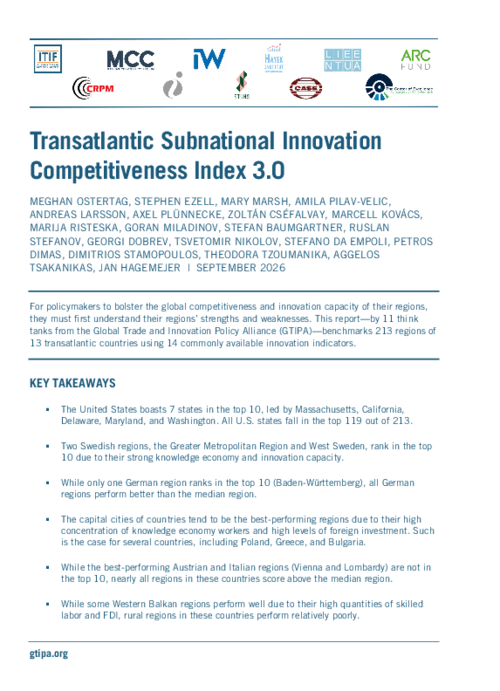
GTIPA Perspectives: Making AI Policy to Drive Innovation
Vera Demary
Germany’s federal structure leads to a diverse landscape of AI policies across the country. While
the EU AI Act establishes a general framework for AI policy throughout the continent, Germany’s
federal government is responsible for national AI policies.
More and more companies in Europe are using artificial intelligence (AI) technologies. In 2025, one in five companies in the EU with 10 employees or more used at least one major AI technology, up from 8% in 2023 (Eurostat, 2026a).
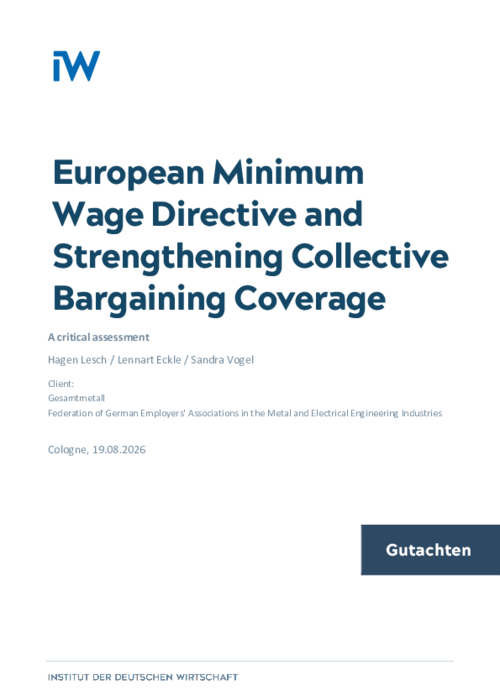
European Minimum Wage Directive and Strengthening Collective Bargaining Coverage
Hagen Lesch / Lennart Eckle / Sandra Vogel
The EU Minimum Wage Directive recommends that EU Member States achieve a collective bargaining coverage of 80 per cent to ensure adequate minimum wages.
Your search returned an incorrect status. You may have selected too many filters. You can jump back to your previous selection to adjust your search.
Content element with id 9713
IW-Newsletter
Subscribe to our newsletters to receive updates on the latest IW publications. Sign up here to stay informed.
This website uses necessary cookies to ensure the operation of the website. You can allow or decline tracking. If you allow tracking, Matomo is used with cookies. You can find detailed information about the use of cookies in our privacy policy.
Warning: You are using an outdated browser!
Please switch to a modern browser (e.g. Google Chrome, Firefox or Microsoft Edge) in order to enjoy the best user experience.


 German Economic Institute (IW)