Making Apprenticeships a Success: From Marketing to Hiring
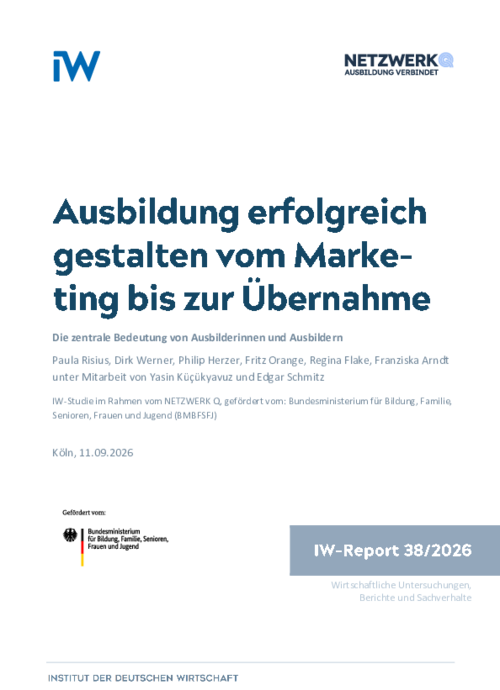
IW-Report No. 38 11. September 2026 Paula Risius / Dirk Werner / Philip Herzer / Fritz Orange / Regina Flake / Franziska Arndt / Yasin Küçükyavuz / Edgar Schmitz Making Apprenticeships a Success: From Marketing to Hiring
In-company vocational training is a key factor in securing skilled labour. The first step in investing in future employees is to approach and recruit new apprentices. For many companies, filling the apprenticeship positions they offer is a challenge.
IW-Report No. 38 11. September 2026 Paula Risius / Dirk Werner / Philip Herzer / Fritz Orange / Regina Flake / Franziska Arndt / Yasin Küçükyavuz / Edgar Schmitz
Making Apprenticeships a Success: From Marketing to Hiring
IW study conducted as part of NETZWERK Q, funded by the Federal Ministry of Education, Family, Senior Citizens, Women, and Youth (BMBFSFJ)
Paula Risius / Dirk Werner / Philip Herzer / Fritz Orange / Regina Flake / Franziska Arndt / Yasin Küçükyavuz / Edgar Schmitz German Economic Institute (IW)
In-company vocational training is a key factor in securing skilled labour. The first step in investing in future employees is to approach and recruit new apprentices. For many companies, filling the apprenticeship positions they offer is a challenge.
Based on a survey of over 600 trainers, the study analyses which measures they consider suitable for attracting apprentices to an apprenticeship programme, supporting them throughout their apprenticeship in line with their needs, equipping them with the necessary skills and subsequently retaining them in the company in the long term. Regarding specific measures, the study’s findings show that successful apprenticeship marketing must consider all phases of the apprenticeship programme as part of a ‘candidate journey’.
Before the apprenticeship begins, measures that enable young people to gain direct insights and make personal contacts are effective, with internships proving particularly successful. When it comes to recruitment, online job advertisements work particularly well, whilst informal get-to-know-you sessions are effective during pre-boarding before the apprenticeship begins. It is still relatively rare for companies to send apprentice ambassadors to schools for vocational orientation or to use low-threshold application formats to facilitate an uncomplicated initial contact. As these tools also work very well, there is still potential here for more companies.
At the start of the apprenticeship, trainers regard social integration as a key factor for success. Welcome formats and team-building activities foster the corporate culture and support the social integration of new apprentices. Mentoring programmes are also successful but are not yet implemented across the board.
During the core phase of the apprenticeship, regular feedback and close links to the company’s processes and workflows make a decisive contribution to the success of the training and to independent learning. Given the increasingly heterogeneous starting points of apprentices, individual support is becoming increasingly important. Around one third of the respondents view this heterogeneity as a major challenge overall. Mental health issues, motivation, performance and concentration levels, as well as differences in trainees’ prior educational knowledge, are particularly challenging. Characteristics such as a migrant background, refugees’ experiences or age, on the other hand, play a significantly lesser role. There is therefore a particular need for support in dealing with individual challenges and differing learning requirements.
All in all, the results show that trainers play a key role and carry out a wide range of tasks throughout all phases of the apprenticeship – from vocational orientation to retention. It is therefore important to create a positive framework for training activities within the company, to clearly define the role of trainers, and to provide them with the necessary time allowances and further training opportunities in line with their needs.
IW-Report No. 38 11. September 2026 Paula Risius / Dirk Werner / Philip Herzer / Fritz Orange / Regina Flake / Franziska Arndt / Yasin Küçükyavuz / Edgar Schmitz
Making Apprenticeships a Success: From Marketing to Hiring
IW study conducted as part of NETZWERK Q, funded by the Federal Ministry of Education, Family, Senior Citizens, Women, and Youth (BMBFSFJ)
Paula Risius / Dirk Werner / Philip Herzer / Fritz Orange / Regina Flake / Franziska Arndt / Yasin Küçükyavuz / Edgar Schmitz German Economic Institute (IW)
IW-Report No. 40 12. September 2025 Paula Risius et al.
The influence of occupational similarity and labor market conditions on occupational change
Germany urgently needs skilled workers in various professions for the energy transition: in the 31 energy-related professions considered in this study, almost 119,000 of the total 185,000 vacancies could not be filled in 2024.
Paula Risius / Valeria Quispe / Lydia Malin / Franziska Arndt / Armin Mertens / Jan Felix Engler IW
IW-Policy Paper No. 14 12. December 2024 Axel Plünnecke
Agenda 2030 for the education policy: Mastering the challenges of transformation
Germany faces the challenge of coping with demographics, decarbonisation, digitalisation and deglobalisation at the same time. Innovative strength and securing skilled labour are crucial for this.
Subscribe to our newsletters to receive updates on the latest IW publications. Sign up here to stay informed.
This website uses necessary cookies to ensure the operation of the website. You can allow or decline tracking. If you allow tracking, Matomo is used with cookies. You can find detailed information about the use of cookies in our privacy policy.
Warning: You are using an outdated browser!
Please switch to a modern browser (e.g. Google Chrome, Firefox or Microsoft Edge) in order to enjoy the best user experience.

 German Economic Institute (IW)