Companies are an important pillar of our economy because they create jobs, prosperity and growth. It is the task of politics to support companies in adapting to a changing environment - for example, to promote research and development.
Companies and Markets

About the topic
The structure of the German and international economy is constantly changing. Companies are challenged to adapt to new realities brought about by digitization, for example. But they are also driving innovation and thus actively shaping change. Politics can support companies in this task by setting the framework conditions favorably. This includes, for example, adjusting the rules for competition, reducing bureaucracy and always maintaining a balance between established companies, such as traditional SMEs, and startups that enrich Germany as a business location with new business models.
 German Economic Institute (IW)
Read the article 
IW-Trends No. 2 11. July 2026
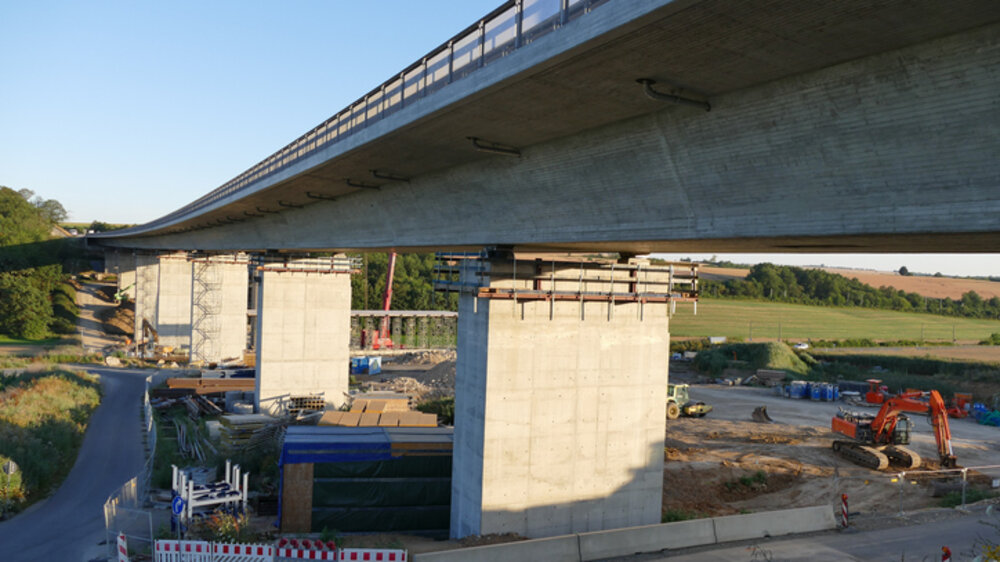
Why Do Companies Invest in Germany?
The growth of Germany’s capital stock is slowing, as current investment increasingly fails to keep pacewith steadily rising disposals. In particular, private investment – which accounts for well over fourfifths of total gross fixed capital formation – has been alarmingly low in recent years.
IW
Read the article 
IW-Report No. 16 13. April 2026
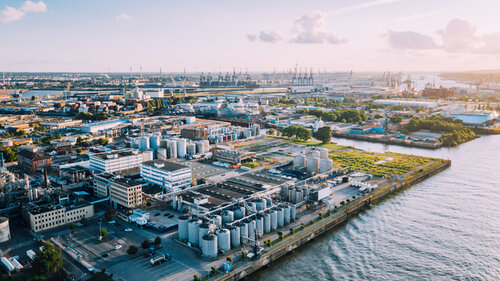
Making transformation risks measurable
The decarbonization of German industry requires fundamental transformations of production processes.
IW
Read the article 
IW-Trends No. 4 26. January 2026
The Role of the Private Sector in Germany's Overall Defence Strategy
The present study analyses the role of the private sector in Germany's national civil and military defence strategy in the light of the deteriorating security situation in Europe.
IW
Read the article 
IW-Trends No. 3 2. October 2025

35 Years of Reunification: What Has Been Achieved in Eastern Germany and Where Are the Biggest Economic Issues?
Over the past 35 years, significant progress has been made in the economic reconstruction in the federal states in Eastern Germany.
IW
Our Experts
View profile 
@iwkoeln.de Barbara Engels @BarEngels
Barbara Engels
Senior Economist for Sustainable Digitalisation and AI
Tel: +49 221 4981-703 Mail: engels View profile 
@iwkoeln.de
Prof. Dr. Michael Grömling
Head of Macroeconomic and the Business Cycle Research Group
Tel: +49 221 4981-776 Mail: groemling
View profile 
@iwkoeln.de Klaus-Heiner Röhl
Dr. Klaus-Heiner Röhl
Senior Economist for SME Policy and Regional Policy
Tel: +49 30 27877-103 Mail: roehl View profile 
@iwkoeln.de Michael Voigtländer @mvoigtlaender
Prof. Dr. Michael Voigtländer
Head of International Economic Policy, Financial and Real Estate Markets Research Unit
Tel: +49 221 4981-741 Mail: voigtlaender Content element with id 9139
All news
1323 results
Sort by:
Date
Read study
Event
14. October 2026
Expert Workshop on the Industrial Accelerator Act
The German Economic Institute (IW) and Frontier Economics are pleased to invite you to a rapporteur & stakeholder workshop on the Industrial Accelerator Act (IAA) in Brussels.
Read study

IW-Trends
No. 3
29. September 2026
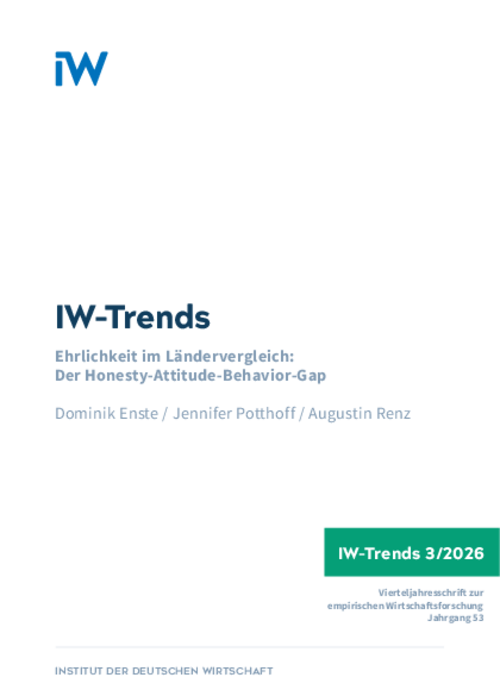
The Honesty-Attitude-Behavior Gap: A Cross-Country Comparison
Honesty reduces transaction costs and is therefore a prerequisite for effective economic cooperation.
Read study
Event
28. September 2026
Online-Veranstaltungsreihe „Von Brüssel nach Berlin”: Regionalentwicklung und Industriepolitik
Wir laden Sie herzlich zu einer weiteren Online-Veranstaltung unserer Veranstaltungsreihe „Von Brüssel nach Berlin“ ein. Mit ihr wollen wir in loser Folge Themen aus der europäischen in die deutsche Hauptstadt tragen.
Read study

External Publication
16. September 2026
Complementary Capabilities for Circular Practices: Firm-Level Evidence in Germany on the Role of Digitalization and Innovation
The transition to a circular economy (CE) requires firms to reconfigure business models, processes and capabilities.
Read study

IW-Report
No. 38
11. September 2026
Making Apprenticeships a Success: From Marketing to Hiring
In-company vocational training is a key factor in securing skilled labour. The first step in investing in future employees is to approach and recruit new apprentices. For many companies, filling the apprenticeship positions they offer is a challenge.
Read study

Expertise
11. September 2026
Transatlantic Subnational Innovation Competitiveness Index 3.0
Innovation and competitiveness drive productivity, economic growth, and welfare growth.
Read study

External Publication
9. September 2026

GTIPA Perspectives: Making AI Policy to Drive Innovation
Germany’s federal structure leads to a diverse landscape of AI policies across the country. While the EU AI Act establishes a general framework for AI policy throughout the continent, Germany’s federal government is responsible for national AI policies.
Read study

Expertise
8. September 2026

AI skills demand in the EU
More and more companies in Europe are using artificial intelligence (AI) technologies. In 2025, one in five companies in the EU with 10 employees or more used at least one major AI technology, up from 8% in 2023 (Eurostat, 2026a).
Read study

Expertise
25. August 2026
European Minimum Wage Directive and Strengthening Collective Bargaining Coverage
The EU Minimum Wage Directive recommends that EU Member States achieve a collective bargaining coverage of 80 per cent to ensure adequate minimum wages.
Read study

IW-Trends
No. 2
6. August 2026
Critical Raw Materials: Corporate Exposure, Supply Risks and Adaptation Strategies
Critical raw materials are vital inputs for key technologies and thus for industrial competitiveness.